
In the world of timber, there exists a hidden hierarchy. While most people are still talking about construction lumber and packaging pallets, a small circle of top architects and collectors have set their sights on one extraordinary resource:Douglas Fir Clear Wood.
It is breaking away from the category of ordinary bulk commodities and evolving into a kind oftime assets embodied in wood.

Douglas Fir, Its scientific name is Pseudotsuga menziesii. It boasts multiple textured aliases in international trade:Oregon Pine or Douglas Fir . It was once the sole choice for crafting aircraft frames and masts of premium tall ships. Boasting an exceptional strength-to-weight ratio, it is hailed as "the load-bearing wall among all timber."
I. The Price of Clear Wood: A 150-Year Natural Closed Loop
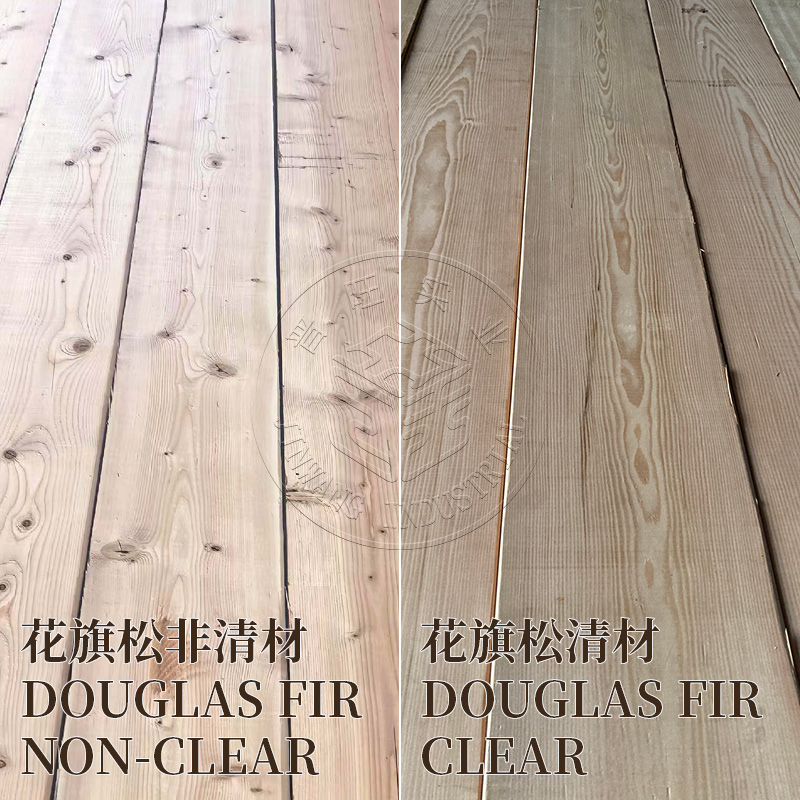
We need to correct a misconception:"Clear of knots" is not processed artificially; it is forged by time.
Trees inevitably grow branches, and branches inevitably form knots. To obtain a flawless clear knot-free timber, the forest must accomplish this highly demanding natural process:
- Extremely dense juvenile growth: Forcing the lower branches to wither and fall off naturally due to lack of sunlight (natural pruning).
- A lengthy “callus healing” process: The trunk needs to keep growing thicker, fully enclosing the traces of fallen branches deep inside.
- The long wait for: From the shedding of branches to the growth of a sufficiently thick outer clear wood layer with absolutely no fiber disturbance, it usually takes More than 120 to 150 years.
Conclusion: Industry can imitate wood grain and synthesize materials, yet no technology can compress this 150 years of physical growth time.
II. Dimensional Strike: Douglas Fir vs. Radiata Pine (Industrial Product vs. Work of Art)
On the market, many people compare Radiata Pine (also known as New Zealand Pine), which is also marketed as "knot-free", with Douglas Fir, yet there is an essential class difference between the two:
| Dimension | Clear Radiata Pine board | Clear Douglas Fir board |
| Growth cycle | 25–30 years (fast-growing plantation forest) | Over 120–150 years (old-growth forest) |
| Causes of Knot-Free Texture | Artificial pruning: Relying on manual pruning to cut off branches | Natural pruning: Relies on centuries of natural survival of the fittest |
| Physical properties | Soft in texture, low in density, and prone to scratches. | Extremely high strength, great hardness, with structural support capacity. |
| Visual texture | Pale and light in color, with sparse wood grain texture | Warm reddish-orange color with silky and extremely fine grain texture. |
| Market positioning | Standardized industrial building materials | Scarce architectural & artistic materials |
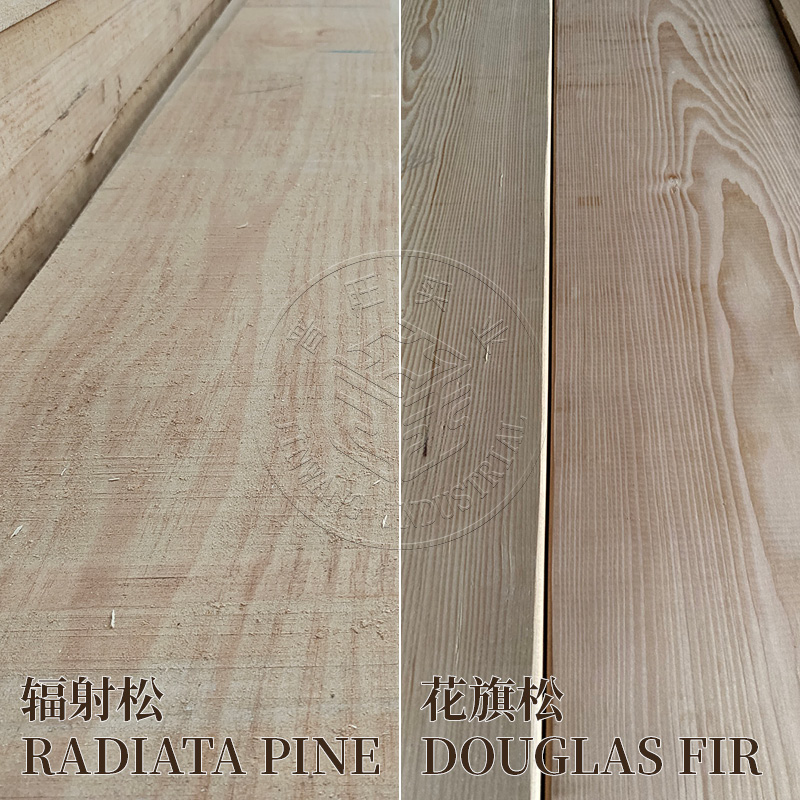
Core Difference: Radiata Pine represents "man-made efficiency", while Douglas Fir embodies "natural precipitation and accumulation".
III. The Crucial 1% Screening: Why It Is a Luxury Material
In the luxury goods industry, scarcity is controlled by brand output; in the timber industry, scarcity is determined by natural probability.
- Inverted resource pyramid: Among global forest resources, planted forests account for the vast majority. To pursue economic benefits, planted forests are typically harvested on a rotation cycle of 30 to 50 years. This means modern forestry has eliminated the possibility of producing knot-free timber right from its gene pool.
- Two sharp drops in timber yield rate:
- First screening: Only old-growth logs with a diameter exceeding 80 cm are qualified to yield clear wood.
- Second screening: Even among such premium-grade logs, the purest outermost portion only accounts for 5%—15%.
- Mathematical Conclusion: Among the total volume of Douglas fir timber circulating globally today, the proportion of materials meeting the high-standard construction requirements—extra-long, knot-free, and straight-grain—is less than 1%.
IV. Supply-side "Cutoff": An Irreversible Contraction
If scarcity is inherent by nature, then the tightening of policies serves as the final straw that breaks the camel's back.
1. Identity transformation from "forest farm" to "heritage"
North America (especially British Columbia, Canada), home to the world's highest-quality Douglas fir, is undergoing profound institutional reforms. The implementation of the "Old Growth Strategic Review" means vast areas of primeval forests have been placed on the list of "deferred logging" or "permanent logging bans".
2. The Industrial Model Moves in the Opposite Direction
Modern forestry management prioritizes short growth cycles and high turnover. Forest owners tend to plant fast-growing, knotty trees mainly used for pulp or structural lumber. Under this model, forests have become mere "timber factories", no longer cradles for premium, high-quality wood like fine craft material. Old-growth forests capable of producing clear, knot-free lumber are dwindling irreplaceably—once harvested, there is virtually no way to replenish them.

V. Correction of Perception: Is It Merely Just "Soft Wood"?
There is a common misconception in the market: "Isn't soft wood just cheap material?"
This is a typical case of "species prejudice" overshadowing quality differences. Botanically, Douglas Fir does not belong to the true pine genus (Pinus); instead, it is a unique species in the Pseudotsuga genus.
- Physical properties:It boasts an exceptional strength-to-weight ratio and was once used to craft wooden frameworks for aircraft.
- Spatial Performance: Top-tier flooring brands such as Dinesen choose Douglas fir for its ability to provide oversized boards up to 15 meters in length with consistently smooth, seamless grain patterns. This ultimate visual sense of calm is incomparable to ordinary, irregular wood grain.
VI. Conclusion: The Luxury Grade Among Timber
When a material meets the following criteria:
- Irreplaceable growth cycle (150+ years)
- Extremely limited origin resources (specific regions on the west coast of North America)
- Cannot be replicated by industrial production (old-growth logging prohibited)
It has completed its leap from a mere "material" to a valuable "asset". The price surge in Douglas fir clear wood is not short-term speculation, but the final warning of the global depletion of old-growth forest resources.
Its value will no longer be determined by the market — but by nature itself.

Author: Jinwang Industrial
[Copyright Statement]
- This is an original work by Jinwang Industrial. All copyrights are reserved by the author.
- Without the official written authorization of the author, no individual or institution may reproduce, excerpt, repost, or publish in any form (including but not limited to text, screenshots, adaptation, etc.).
- Authorized reproductions must be marked with "Source: Jinwang Industrial" and may not distort or alter the original text in any way.
- Infringement Prohibited & Liable: For any unauthorized plagiarism, content rewriting and infringement acts, our company reserves the right to pursue legal liabilities through judicial means, including but not limited to applying for evidence preservation on relevant platforms, issuing legal demand letters and filing lawsuits.